


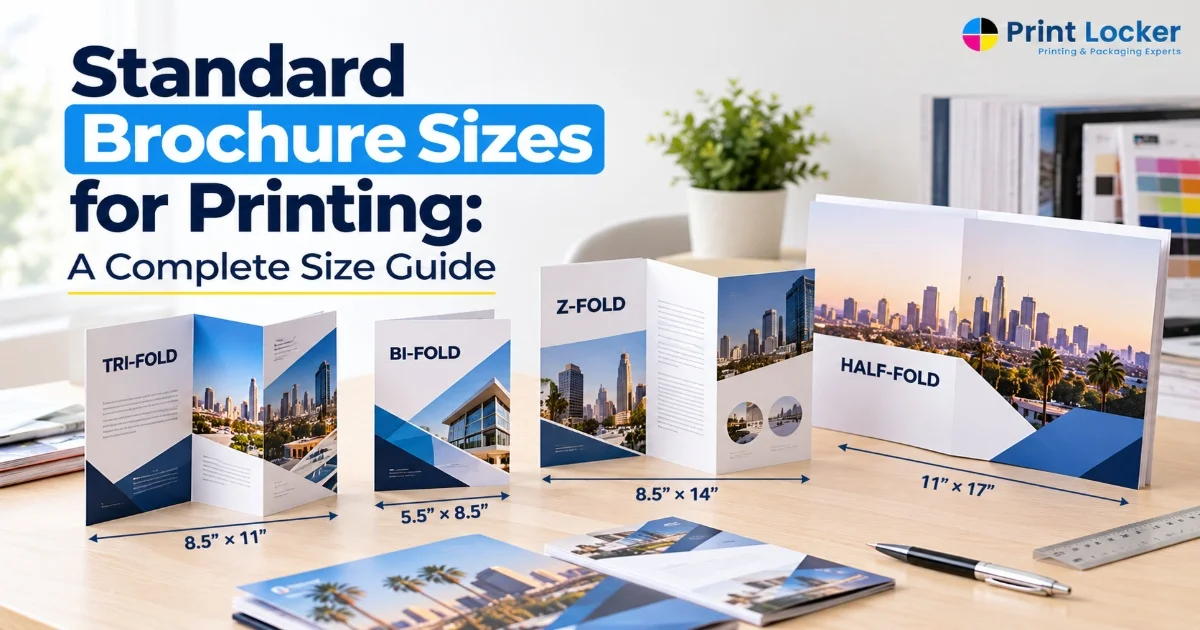
Selecting an appropriate size for a brochure is an essential factor of creating a professional printed marketing product. Out of all criteria determining the size, the most crucial ones are the quantity of information included, different brochures’ folds, easy distribution and placement of materials on a page.
Typically, the most frequently used size for printed materials in the U.S. is 8.5 x 11 inches. Nevertheless, small and big sizes can be good choices depending on how much content there will be in the brochure.
What Is the Standard Brochure Size?
There isn’t one size that fits all brochures. The proper size depends on the style of folding, the content of the brochure, the method of distribution, and the design requirements.
The most common format in the USA is 8.5 × 11 inches, which is also referred to as US letter size. When this paper is folded in three sections, it forms a unique tri-fold brochure with six panels.
When discussing brochure dimensions, it is important to distinguish between:
- Flat size: The dimensions of the brochure before folding.
- Finished size: The dimensions after the brochure has been folded.
- Panel size: The individual sections created by the fold.
- Trim size: The final dimensions after the printed sheet is cut.
It is advisable to provide the printer with both flat size and folding type of your brochure, not only the finished size, to minimize any confusion.
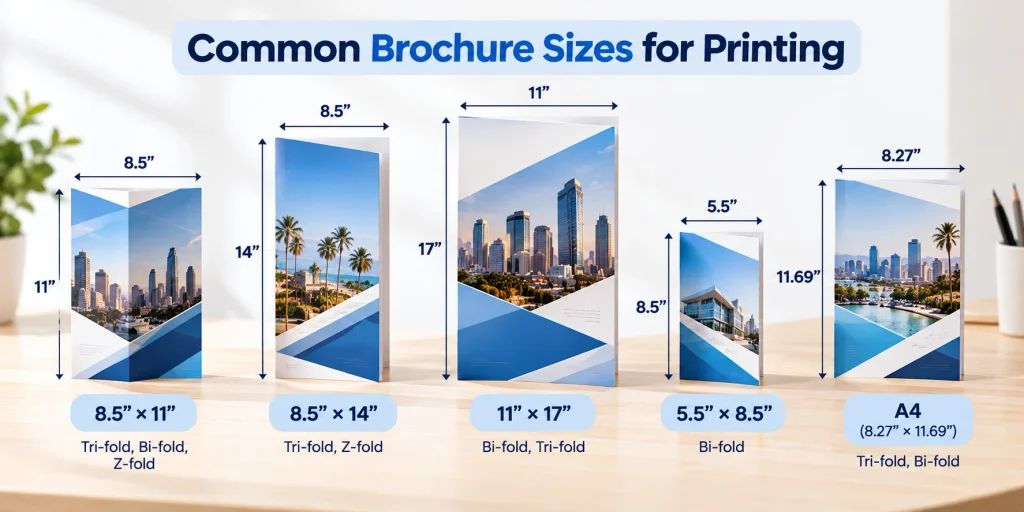
Common Brochure Sizes for Printing
Here are several brochure dimensions commonly used for U.S. printing:
| Brochure Size | Common Fold | Typical Use |
| 8.5 × 11 in. | Tri-fold, Bi-fold, Z-fold | Business brochures, services, marketing |
| 8.5 × 14 in. | Tri-fold, Z-fold | Detailed services, menus, guides |
| 11 × 17 in. | Bi-fold, Tri-fold | Large presentations, maps, image-heavy brochures |
| 5.5 × 8.5 in. | Bi-fold | Compact brochures, handouts |
| A4 (8.27 × 11.69 in.) | Tri-fold, Bi-fold | International audiences |
The exact folded dimensions depend on the fold style and how the panels are configured.
8.5 × 11 Inch Brochures
The 8.5 × 11 inch format is one of the most versatile choices for brochure printing in the United States.
It works well for:
- Business and corporate brochures
- Service descriptions
- Real estate marketing
- Healthcare information
- Event information
- Product presentations
- Restaurant and hospitality materials
This letter-sized paper can be folded into half, which results in about 8.5 × 5.5 inch size, or folded into thirds to create a tri-fold brochure.
8.5 × 14 Inch Brochures
An 8.5 × 14 inch sheet is bigger than the standard letter size sheet and has the same width.
It can be useful when your brochure needs additional space for:
- Multiple services
- Product information
- Menus
- Maps
- Detailed descriptions
- Step-by-step information
A legal-sized sheet can also be folded into sections, which gives bigger areas compared to standard letter-sized tri-fold brochures.
11 × 17 Inch Brochures
While an 11×17 sheet of paper may seem a little too large for creating a standard letter-size brochure, there are many reasons to choose this larger format.
This larger format can work particularly well for:
- Product presentations
- Real estate information
- Maps and floor plans
- Large photographs
- Detailed marketing materials
- Corporate presentations
For example, folding the 11×17 paper in half will give the finished brochure an approximate size of 8.5×11.
5.5 × 8.5 Inch Brochures
Similarly, a 5.5×8.5 format is the best option in cases where portability is important. It offers a smaller size brochure while still having enough space for brief information.
Consider this size for:
- Small business handouts
- Event information
- Compact service guides
- Product information
- Promotional inserts
Using this smaller format makes it easier to carry and distribute the brochures during different events.
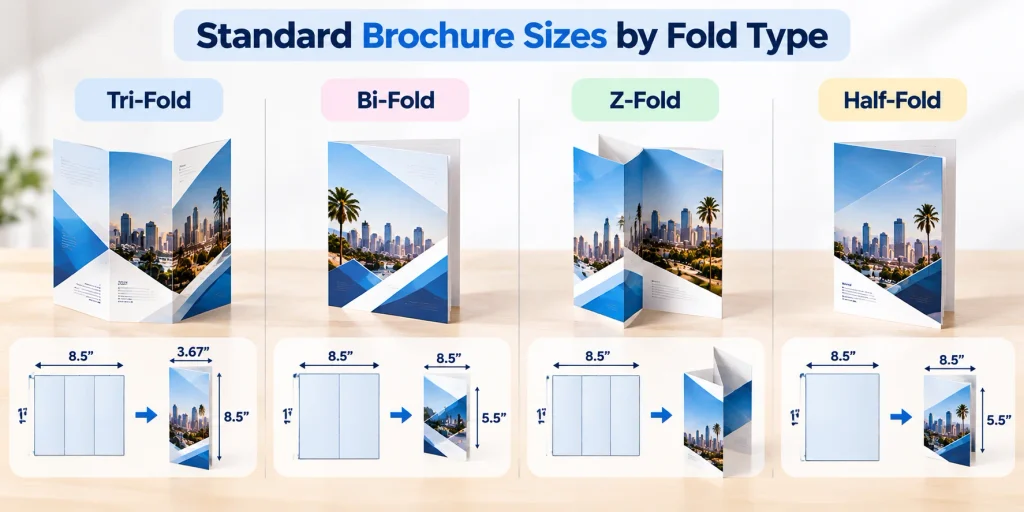
Standard Brochure Sizes by Fold Type
The fold type influences the amount of usable area available for the brochure. PrintLocker features several folds available, such as a bi-fold, tri-fold, Z fold, French fold, and gate fold.
Tri-Fold Brochure Size
A tri-fold brochure begins as a flat sheet divided into three panels on either side, and opens to create six panels altogether.
The most common U.S. example is:
Flat size: 8.5 × 11 inches
Folded size: Approximately 3.67 × 8.5 inches
It is commonly used for:
- Service brochures
- Travel information
- Healthcare materials
- Real estate
- Restaurant menus
- Business promotions
The panel that is folded inside may require being a bit smaller than normal, depending on the kind of stock and type of fold used; hence it is better to use the template from the printer before making the design.
Bi-Fold Brochure Size
In a bi-fold brochure, one fold is made in the center of the paper, creating four panels.
For an 8.5 × 11 inch sheet:
Flat size: 8.5 × 11 inches
Finished size: Approximately 8.5 × 5.5 inches
This layout creates bigger columns compared to the tri-fold and comes in handy when you wish to project your information in a simple and neat way.
Z-Fold Brochure Size
For a Z-fold brochure, there are two folds made in the opposite directions, creating an accordion-style appearance.
It is useful when information needs to be presented in a sequence, such as:
- Instructions
- Product features
- Service steps
- Timelines
- Event information
An 8.5 × 11 inch sheet is a common starting format for a Z-fold brochure.
Half-Fold Brochure Size
A half-fold divides the sheet into two equal sections.
An 8.5 × 11 inch sheet becomes approximately:
8.5 × 5.5 inches when folded
This format can work well for menus, programs, presentations, and straightforward business information.
How to Choose the Right Brochure Size
Choosing the proper size isn’t based on a universal standard but on the brochure’s purpose.
Consider these factors:
- Amount of content: More text and images may require a larger format.
- Fold style: Different folds create different panel arrangements.
- Distribution: Consider whether the brochure will be mailed, handed out, or displayed in a rack.
- Images: Large photographs may benefit from larger panels.
- Portability: Smaller brochures can be convenient for events and handouts.
- Budget: Paper size, folding, quantity, and finishing can affect production costs.
Make a rough outline of the content before choosing a size for the brochure. That way, you will see whether a small tri-fold is enough or look for a larger format to present your message.
What Size Should You Use for a Business Brochure?
The majority of businesses prefer to go with the dimensions of 8.5 × 11 inches because it can be folded in multiple ways and has space for marketing content that needs to be included in a brochure.
A business brochure might include:
- Company introduction
- Products or services
- Key benefits
- Supporting images
- Contact information
- A call to action
If you have a lot of content to add, then you may want to choose dimensions of either 8.5 × 14 inches or 11 × 17 inches so that your content can fit in properly.
Businesses looking for a Brochure printing service in California can also discuss their intended use, content volume, fold style, and paper requirements with the printer before selecting the final dimensions.
What Are the Best Margins and Bleeds for Brochure Printing?
When printing a brochure, the print file requires not only the final size of the brochure. You will also need to consider bleed, trim, and safety areas.
As a general production practice:
- Extend background colors and images beyond the trim edge when bleed is required.
- Keep important text and logos away from fold and trim lines.
- Use the printer’s specific template whenever available.
- Check the fold positions before finalizing the design.
- Confirm the required file format and resolution with your printer.
Remember that bleed requirements may vary from printer to printer and from product to product. Always follow the particular requirements of your brochure job instead of assuming that the requirements are the same for all jobs.
For businesses ordering from a Brochure printing service in Los Angeles, checking the printer’s artwork specifications before submitting files can help avoid issues such as text being too close to a fold or artwork being cropped unexpectedly.
Common Mistakes When Choosing a Brochure Size
Choosing a brochure size based on nothing but available paper can cause complications later. Watch for these common mistakes:
- Choosing a size before deciding on the fold.
- Trying to fit too much text into a small format.
- Forgetting to account for fold positions.
- Designing without considering the finished folded size.
- Placing important information directly on fold lines.
- Using low-resolution images.
- Ignoring bleed and safe-area requirements.
- Assuming every printer uses identical templates.
A simple proof or a digital mockup can give you a preview of what the content will look like in a printed brochure.
How to Prepare Your Brochure for Printing
Once you have created your brochure design, remember to inspect the whole file through the printer’s production perspective.
A useful checklist includes:
- Confirm the flat and finished dimensions.
- Confirm the fold type.
- Check panel order and fold placement.
- Use high-resolution images.
- Review spelling and contact information.
- Check bleed and safe margins.
- Make sure colors and fonts are prepared according to the printer’s specifications.
- Review a final proof before production.
If you have a deadline for an upcoming event, promotion, or business launch, a Same day Brochure printing service in Los Angeles & Nearby areas may be an option for qualifying projects. Turnaround depends on the specific size, quantity, paper, folding, artwork readiness and production requirements.
The right brochure size will vary across every specific project. Your choice should depend on the content you plan to include in it, the fold style, the target audience, the method of distribution, and the preferred presentation option. It is important to determine the correct dimensions before you start designing your brochure to make the process much more effective. It is recommended to consult your printer regarding the performance specifications and actual dimensions of your brochure before you send the project for print.
❓ FAQs
Q1: What is the standard size of a brochure?
A common U.S. brochure size is 8.5 × 11 inches before folding, especially for tri-fold and bi-fold formats.
Q2: What is the most common brochure size?
The 8.5 × 11 inch letter-size format is one of the most commonly used brochure sizes in the U.S.
Q3: What size is a tri-fold brochure?
A standard U.S. tri-fold commonly starts with an 8.5 × 11 inch sheet and folds to approximately 3.67 × 8.5 inches.
Q4: What is the best size for a business brochure?
The best size depends on your content, fold style, distribution method, and design. 8.5 × 11 inches is a versatile starting point for many business brochures.
Q5: What size should a brochure be for printing?
Common options include 8.5 × 11, 8.5 × 14, and 11 × 17 inches, with the final choice depending on the amount of content and intended fold.


