


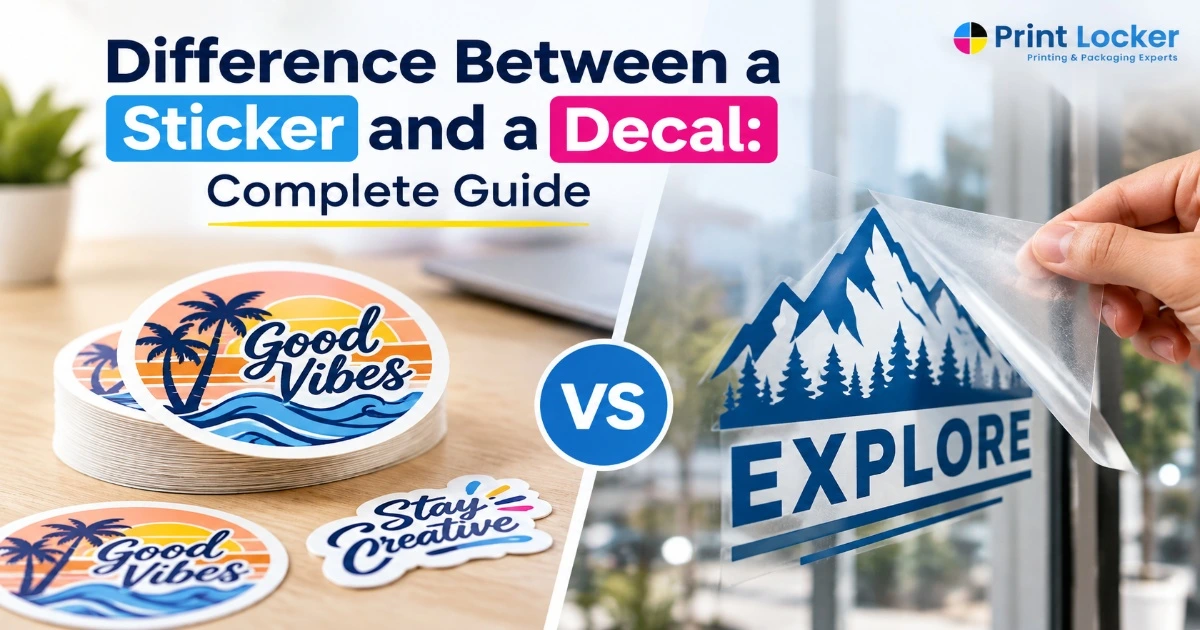
Stickers and decals can be used for branding, decoration, product identification, and promotion. Many people think they are the same as they both may have logos, images, text, and custom designs. However, the two words are not interchangeable, and there are practical differences when it comes to production, application, and usage.
Knowing the difference between a sticker and a decal can help you choose the right product for your project. You may need some graphics for packaging, marketing material, vehicle and window signs, etc. And understanding how these concepts operate will make the printing process easier for you.
What Is a Sticker?
A sticker is basically a graphic design that has glue on one of its sides. The other side usually has backing which is removed before placing the sticker on a surface. There are various types of stickers based on how they look, their color and material.
Stickers can be made of paper, plastic or vinyl. Vinyl is one of the best materials to use when you want to have resistance to moisture and where regular handling is expected.
Stickers are commonly used for:
- Product labels and packaging
- Brand logos
- Promotional giveaways
- Laptop and water bottle decoration
- Event promotions
- Mailers and marketing materials
- Retail products
The beauty of stickers is that they are easy to use. In most cases, you do not need any special tools to put a sticker on a surface since one needs simply to peel the backing off and press the sticker on the surface.
What Is a Decal?
A decal is defined as a design that can be applied on to a surface, with the main goal being to give out the clean and unique look of the surface. Decals can be categorized in the following manner: vinyl graphics, lettering, window graphics, vehicle graphics, wall applications, etc.
Depending on the type of decals, they can either be printed or cut from vinyl. Some types of decals utilize transfer tape to facilitate the transfer process on to the surface, while keeping the letters or graphics in their original place.
Decals are commonly used for:
- Vehicle graphics
- Window branding
- Wall graphics
- Storefront lettering
- Business logos
- Promotional displays
- Directional graphics
The exact construction of a decal can vary between printers, so it is useful to check how the product is produced and applied before ordering.
Sticker vs. Decal: Key Differences
The biggest differences are usually related to application, appearance, material, and intended use rather than simply the name of the product.
| Feature | Sticker | Decal |
| Application | Usually peel-and-stick | May use transfer tape or direct application |
| Design | Printed artwork is common | Printed or cut artwork |
| Shape | Standard or custom-cut | Often follows the design outline |
| Common Uses | Labels, packaging, promotions | Windows, vehicles, walls, lettering |
| Material | Paper or vinyl | Frequently vinyl |
| Application Skill | Generally simple | May require more careful positioning |
It is important to remember that these categories are not absolute. A durable vinyl sticker can perform a similar function to a decal, and different printing companies may use the terms differently.
Are Stickers and Decals the Same Thing?
Not exactly, but there is some overlap.
The word sticker generally describes an adhesive graphic that sticks directly to a surface. Decal is often used for a graphic that is transferred onto a surface, particularly when the final design is intended to look more integrated with the surface.
For example, a logo can be produced as a sticker, which would simply consist of the company’s logo printed on a rectangular backing. In contrast, if the name of the company has been cut out of vinyl and has been placed directly onto a shop window, it is usually referred to as a decal.
However, it should be emphasized that the terminology does not have a standard approach among all printing services. Thus, when placing an order, focus on the specifics of the material, adhesive, cutting pattern, method of application, and type of the covered surface.
Sticker vs. Decal: Which Is Better?
There is no single option that is better for every project. The right choice depends on where the graphic will be used and how you want it to look after application.
Choose a Sticker When:
- You need a simple peel-and-stick application.
- You are labeling products or packaging.
- You want a full-color printed design.
- You need promotional giveaways.
- You want a graphic that can be produced in many shapes and sizes.
- You are applying the graphic to products, mailers, laptops, or similar surfaces.
Choose a Decal When:
- You need lettering or a graphic applied directly to a surface.
- You are creating vehicle graphics.
- You need storefront or window graphics.
- You want a design without a visible rectangular background.
- You need a wall or display graphics.
- You are comfortable using a transfer application method when required.
The surface itself should also influence your decision. A smooth, clean surface is generally easier to work with than a textured or uneven one.
Types of Stickers
Stickers can be produced in several formats depending on the design and application.
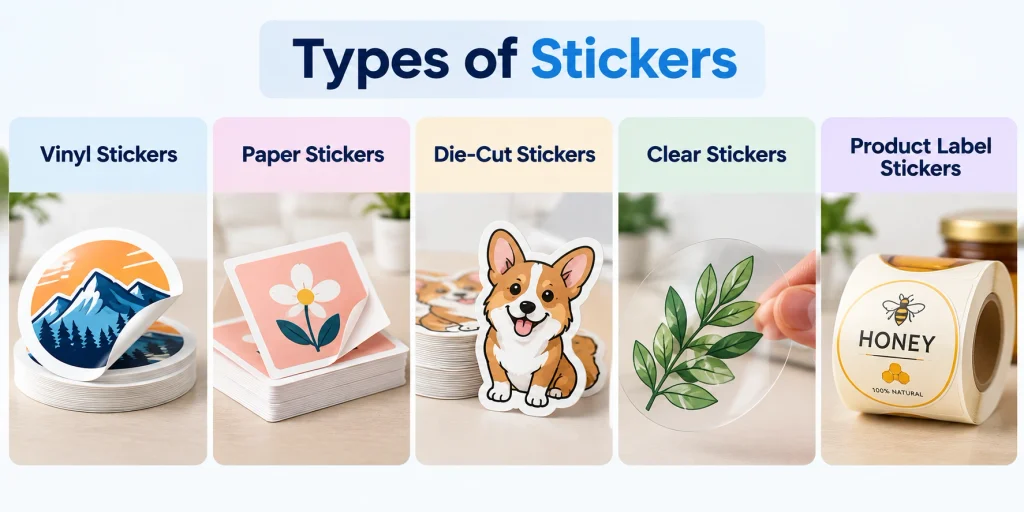
Vinyl Stickers
Vinyl stickers are perfect for applications where moisture and durability measure significant factors. These can be made in matte and glossy finish types.
Paper Stickers
When it comes to paper stickers, these are usually suitable for indoor applications and cannot serve as durable answers to the needs of users who need an option for long-term use.
Die-Cut Stickers
Die-cut stickers are cut around the shape of the artwork rather than being restricted to a standard rectangle or circle.
Clear Stickers
These are made of the transparent material that allows one to see the surface behind the design.
Product Label Stickers
These stickers are used in product packaging and involve information like branding, product name, or ingredients, among others.
Types of Decals
Decals can also be produced in several forms.
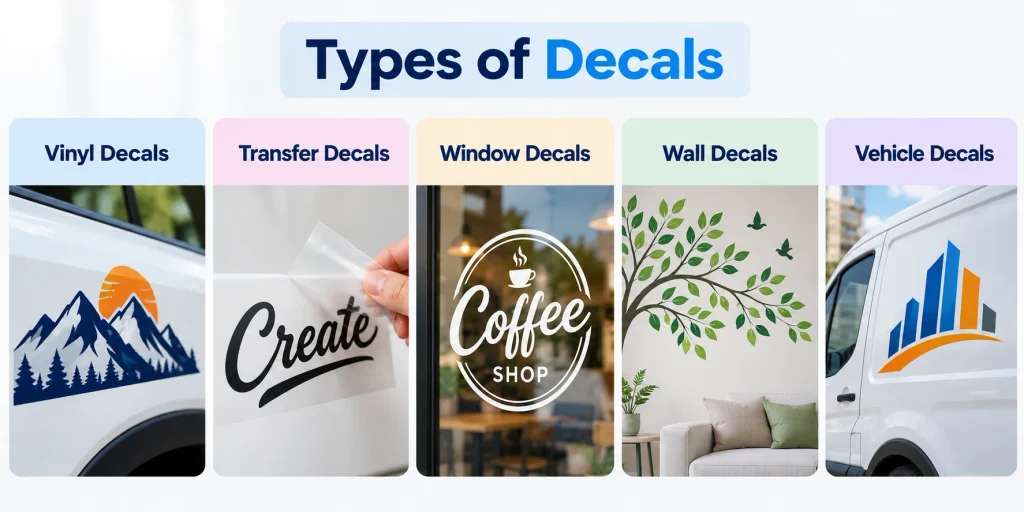
Vinyl Decals
Vinyl decals are specifically designed for graphics printed on smooth surfaces like vehicles, windows, and walls.
Transfer Decals
Transfer decals use an application layer to help move the design from its backing onto the final surface while maintaining the correct arrangement of individual elements.
Window Decals
Window decals are printed for glass and are mainly used for business names, promos, operative hours, and branding.
Wall Decals
Wall decals are meant to be used for indoor branding, art design, office graphics, and wayfinding.
Vehicle Decals
With the help of vehicle decals, the names of companies, logos, contacts, or any other brand elements can be displayed.
How to Choose Between a Decal and a Sticker
Before ordering, consider the following factors:
- Surface: Determine whether you are applying the graphic to packaging, glass, metal, painted surfaces, plastic, or another material.
- Application: Decide whether you want a simple peel-and-stick application or a transfer-style application.
- Design: Full-color artwork may be better suited to a printed sticker, while lettering and simple shapes may work well as cut decals.
- Durability: Consider how long the graphic needs to remain in place and whether it will be exposed to moisture, sunlight, handling, or weather.
- Size: Larger graphics may require a different production and application approach than small labels.
- Removal: If the graphic is temporary, check whether the selected material and adhesive are appropriate for your intended use.
If you are unsure regarding your choice, provide the printer with information about the surface, dimensions, artwork, location, and purpose of the graphic.
Common Uses for Custom Stickers and Decals
Stickers and decals can serve a variety of purposes for businesses. For example, manufacturers might use stickers to label or package their products while retail companies can take advantage of stickers for advertising and brand recognition.
In addition, decals serve the purpose of enabling branding messages to be integrated into a space or surface. For instance, a store sign or office wall design makes branding visible without actually having to use an ordinary sign.
For businesses looking for a sticker printing service in California, the project requirements should be discussed before production, especially when choosing between paper, vinyl, clear materials, different finishes, or custom-cut shapes.
A Sticker printing service in Los Angeles can also be useful for businesses that need locally coordinated sticker production for packaging, promotions, events, or brand materials. PrintLocker offers custom sticker options including different shapes, sizes, finishes, and materials for business applications.
How to Prepare Artwork for Stickers or Decals
Preparing your artwork correctly can help avoid production issues and produce a final product that matches the designs you intended.
Before sending your artwork, check these points:
- Use high-resolution artwork.
- Confirm the final dimensions.
- Keep important text away from edges and cut lines.
- Check whether bleed is required.
- Provide vector artwork when appropriate for cut graphics.
- Confirm whether a transparent background is needed.
- Review spelling, contact details, and logo placement.
- Request or review a proof before production.
For decals that use individual letters or separated graphic elements, the cut lines and transfer process are particularly important. A production-ready file should clearly communicate which parts of the design need to be cut and which areas should remain.
Although stickers and decals are alike, deciding which one to select will depend on how each product is made, affixed, and utilized. Stickers are more often used for product labeling, packaging, giveaways, and full color graphics; decals are associated with lettering, vehicle graphics, windows, walls, and designs that are transferred directly to the surface.
Before you make an order, you should consider the surface you will apply the product to, the artwork used, the size, the durability of the product, its installation method, and its expected lifespan.
❓ FAQs
Q1: What is the difference between a sticker and a decal?
A sticker usually has a peel-and-stick adhesive backing, while a decal is often transferred onto a surface, particularly for vinyl graphics and lettering.
Q2: Are decals better than stickers?
Neither is universally better. The right choice depends on the surface, application method, durability, and intended use.
Q3: What is a decal used for?
Decals are commonly used for vehicles, windows, walls, storefronts, signs, and business branding.
Q4: Can stickers be used outdoors?
Yes. Outdoor-rated vinyl stickers can be suitable for outdoor use when the material, adhesive, and finish are designed to withstand the intended conditions.
Q5: Are vinyl decals and stickers the same?
Not always. Both can be made from vinyl, but decals are often designed for transfer application, while stickers typically have an adhesive backing that is peeled and applied directly.


