


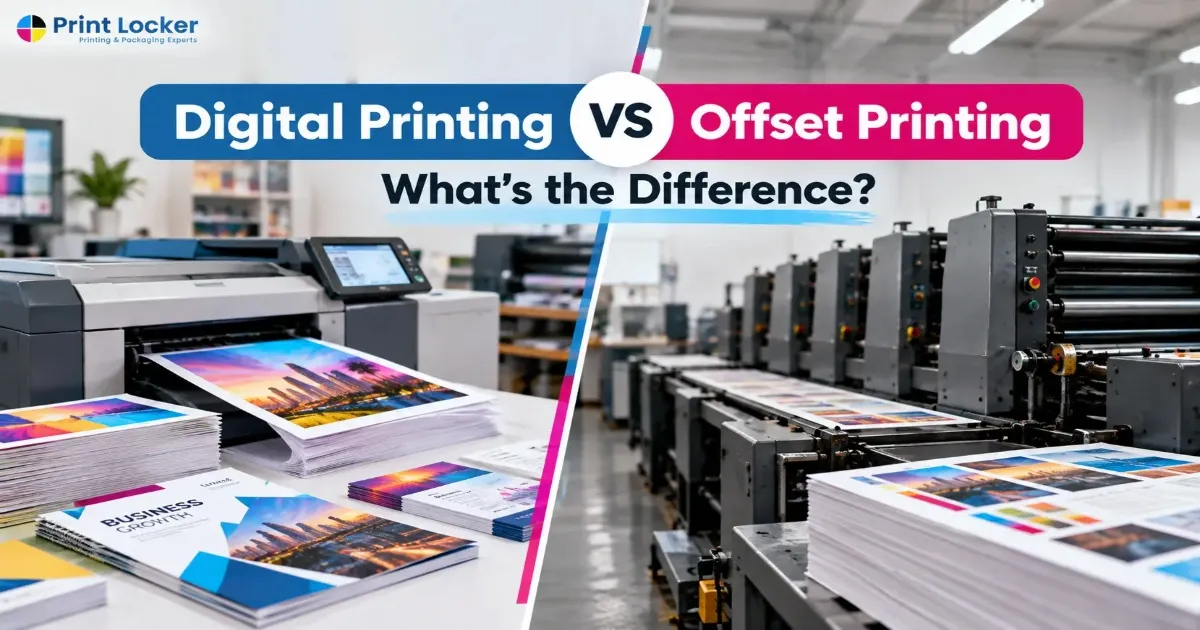
Selecting an appropriate printing technique is vital for obtaining good quality printer tasks in terms of their price and delivery period, and some other factors as well. Companies often must choose between digital printing and offset printing when ordering brochures, postcards, business cards, flyers, catalogs, and other print advertising. The difference between these two techniques is that while both of them are capable of delivering high-quality prints, they operate differently and suit various tasks.
Getting the basics of how both methods function will allow you to choose the one that better fits your order considering the number of prints, deadlines, budget, design requirements, and the intended use of printed materials.
What Is Digital Printing?
Digital printing is a modern printing technique that prints the digital file straight on the paper or another surface. Unlike the conventional offset printing, there is no requirement of printing plates.
The process is relatively straightforward:
- Your design is prepared as a digital file.
- The file is sent directly to the digital printer.
- The printer applies toner or ink to the selected material.
- The finished pieces are printed, cut, folded, or finished as required.
Since there is no need for printing plates, digital printing is very valuable when printing small volumes or quick deliveries.
The commercial usage includes printing business cards, flyers, postcards, brochures, posters, stickers, booklets, and promotional products.
What Is Offset Printing?
Offset printing is a traditional commercial printing process that uses printing plates to transfer an image onto a rubber blanket and then onto the printing surface.
The basic process involves:
- Preparing the artwork for production
- Creating printing plates
- Transferring ink from the plates to a rubber blanket
- Transferring the image from the blanket onto paper
- Completing cutting, folding, binding, or other finishing processes
Although the offset printing process can require more setup than digital printing, the process becomes very efficient when it is completed with bigger print runs. As a result, offset printing is widely used for commercial printing projects where quality, quantity, and efficiency matter.
Digital Printing vs Offset Printing: Key Differences
The key difference between both processes is that printing images is done differently. The process of digital printing involves transferring an image via a digital file whereas for offset printing plates are used to transfer images onto paper.
| Feature | Digital Printing | Offset Printing |
| Printing process | Direct from digital file | Uses printing plates |
| Setup time | Generally shorter | Requires more setup |
| Small quantities | Well suited | Often less economical |
| Large quantities | Can be suitable | Often efficient for high volumes |
| Turnaround | Generally faster | Usually requires more production time |
| Customization | Easy to change between prints | Better suited to consistent runs |
| Variable data | Highly suitable | More limited |
| Color consistency | High quality | Excellent consistency for long runs |
| Initial setup | Lower | Higher |
| Best for | Short runs and quick projects | Larger commercial print runs |
The best method depends on the project rather than one method being universally better.
When Should You Choose Digital Printing?
When flexibility and delivery time are critical, digital printing could prove to be a viable alternative.
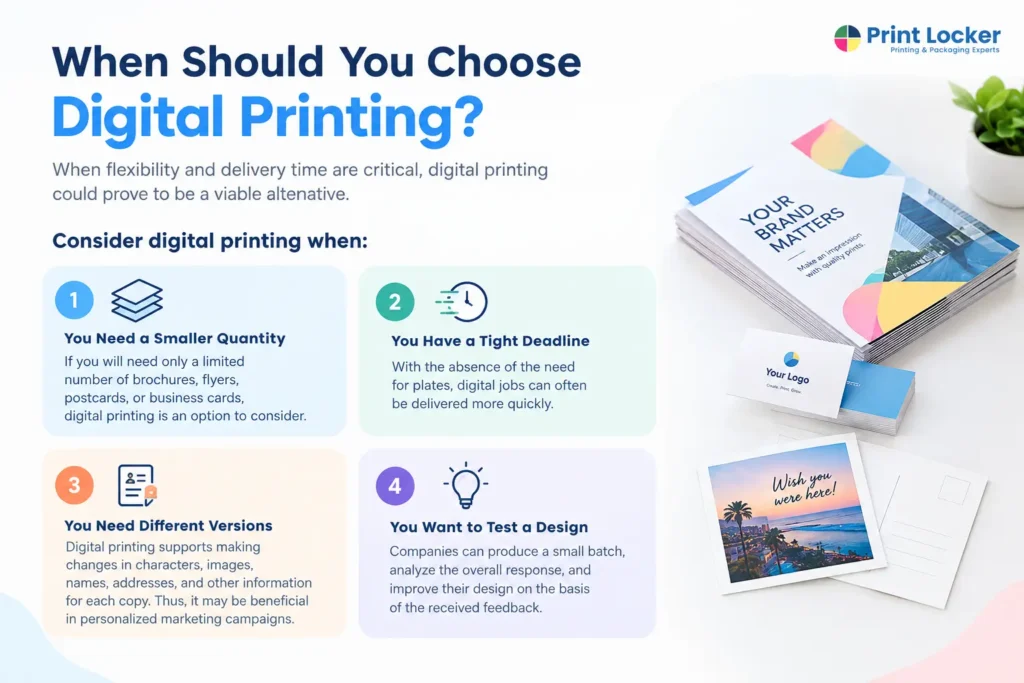
Consider digital printing when:
1. You Need a Smaller Quantity
If you will need only a limited number of brochures, flyers, postcards, or business cards, digital printing is an option to consider.
2. You Have a Tight Deadline
With the absence of the need for plates, digital jobs can often be delivered more quickly.
3. You Need Different Versions
Digital printing supports making changes in characters, images, names, addresses, and other information for each copy. Thus, it may be beneficial in personalized marketing campaigns.
4. You Want to Test a Design
Companies can produce a small batch, analyze the overall response, and improve their design on the basis of the received feedback.
If you need Printing Services in Los Angeles, it is beneficial to go for digital printing when you need flexibility or quick production.
When Should You Choose Offset Printing?
When it comes to bigger commercial projects, offset printing is usually a good option, especially if it is important to produce a large number of identical materials.
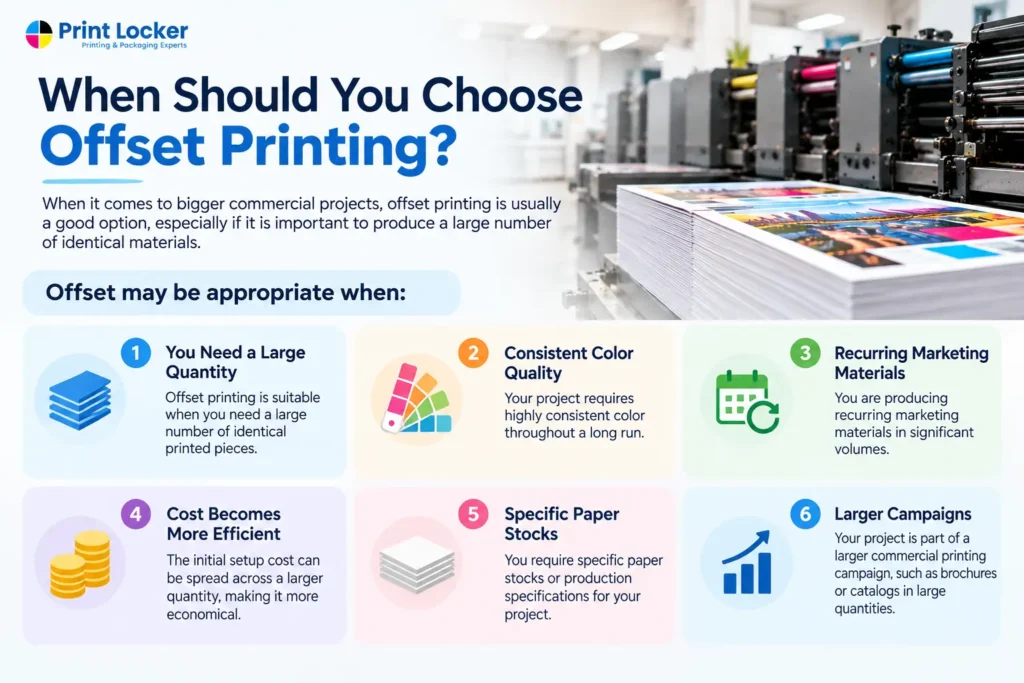
Offset may be appropriate when:
- You need a large quantity of identical printed pieces.
- Your project requires highly consistent color throughout a long run.
- You are producing recurring marketing materials in significant volumes.
- The initial setup cost can be spread across a larger quantity.
- You require specific paper stocks or production specifications.
- Your project is part of a larger commercial printing campaign.
As an example, a company producing tens of thousands of brochures or catalogs might choose offset printing in order to produce its promotional materials.
Which Method Is More Cost-Effective?
There can’t be one right answer because costs depend on the quantity, paper, size, ink coverage, and other factors.
Small print runs usually do better with digital printing since it requires less setup costs. However, as quantities grow larger, the offset printing process usually takes over since the overheads become less significant as a result of spreading them over larger numbers of pieces.
When evaluating your printing estimates, never focus only on the cost per unit without taking into account the total price of your order, the duration of printing, finishing requirements, delivery time, and the required quantity.
How PrintLocker Can Help
PrintLocker offers an extensive selection of printing and promotional services to meet the printing needs of organizations. Its list of print products includes business cards, brochures, postcards, booklets, flyers, catalogs, posters, banners, packing materials, envelopes and other promotional print collateral. Presently, PrintLocker offers both general and specialized services near Los Angeles.
For instance, companies needing Brochure Printing Services In Los Angeles should consider how they would like their brochures printed depending on the quantity needed, time taken to get their products, type of paper used in printing, folding style chosen, among other requirements.
At the same time, companies that wish to send direct mailers can take advantage of Postcard Printing Services In Los Angeles which helps them decide on the most fitting way of doing this depending on the scale of the campaign and specifics of the order.
At PrintLocker, we offer large-scale printing services designed specifically to serve businesses with big printing needs. In our case, companies can order marketing materials, promotional supplies, and various printed products in bulk.
Other Factors to Consider Before Choosing a Printing Method
The printing process is only one part of a successful project. Before placing an order, consider these factors:
Quantity
Identify how many items you need. If you order much more than necessary, you might end up with waste and extra storage.
Turnaround Time
In case the materials are necessary for some event, presentation, exhibition, or campaign, the time of production should be taken into account from the beginning.
Paper and Material
Different projects require different paper types and finishes. A premium business card will require thicker paper, while a giant poster may need an entirely different type of material.
Finishing
Depending on the technique, folding, cutting, binding, lamination, foiling, UV coating, etc. can impact both the look and requirements of your printed project.
Design and File Quality
Even if a high-quality printing process is used, if the file itself has been poorly designed, the final outcome will not meet expectations. It is important to check dimensions, resolution, color settings, bleed, and safety areas in the graphics before production.
Digital and offset printing are well-known printing techniques, however, they differ considerably. Digital printing is usually linked to flexibility, small quantities, custom-made products, and rapid production; as opposed to this, offset printing is generally associated with big-volume projects which require stable and repeated results.
The best option depends on the particular characteristics of your project. Considering the need for the printed product in terms of quantity, delivery date, cost, materials, finishing, and design, you can find the most suitable printing method for your business.
❓ FAQs
Q1: What is the difference between digital printing and offset printing?
Digital printing prints directly from a digital file, while offset printing uses printing plates to transfer the image onto paper.
Q2: Is digital printing cheaper than offset printing?
Digital printing is generally more cost-effective for small quantities, while offset printing can become more economical for larger print runs.
Q3: Which is better for small print runs, digital or offset printing?
Digital printing is generally better suited to small print runs because it requires less setup and offers faster production.
Q4: Which printing method is better for large quantities?
Offset printing is often suitable for large quantities because its setup costs can be spread across a larger number of printed pieces.
Q5: Does PrintLocker offer digital and offset printing?
Yes. PrintLocker provides printing solutions for different project requirements, including commercial and bulk printing, with the appropriate printing method depending on the product, quantity, and specifications.


