
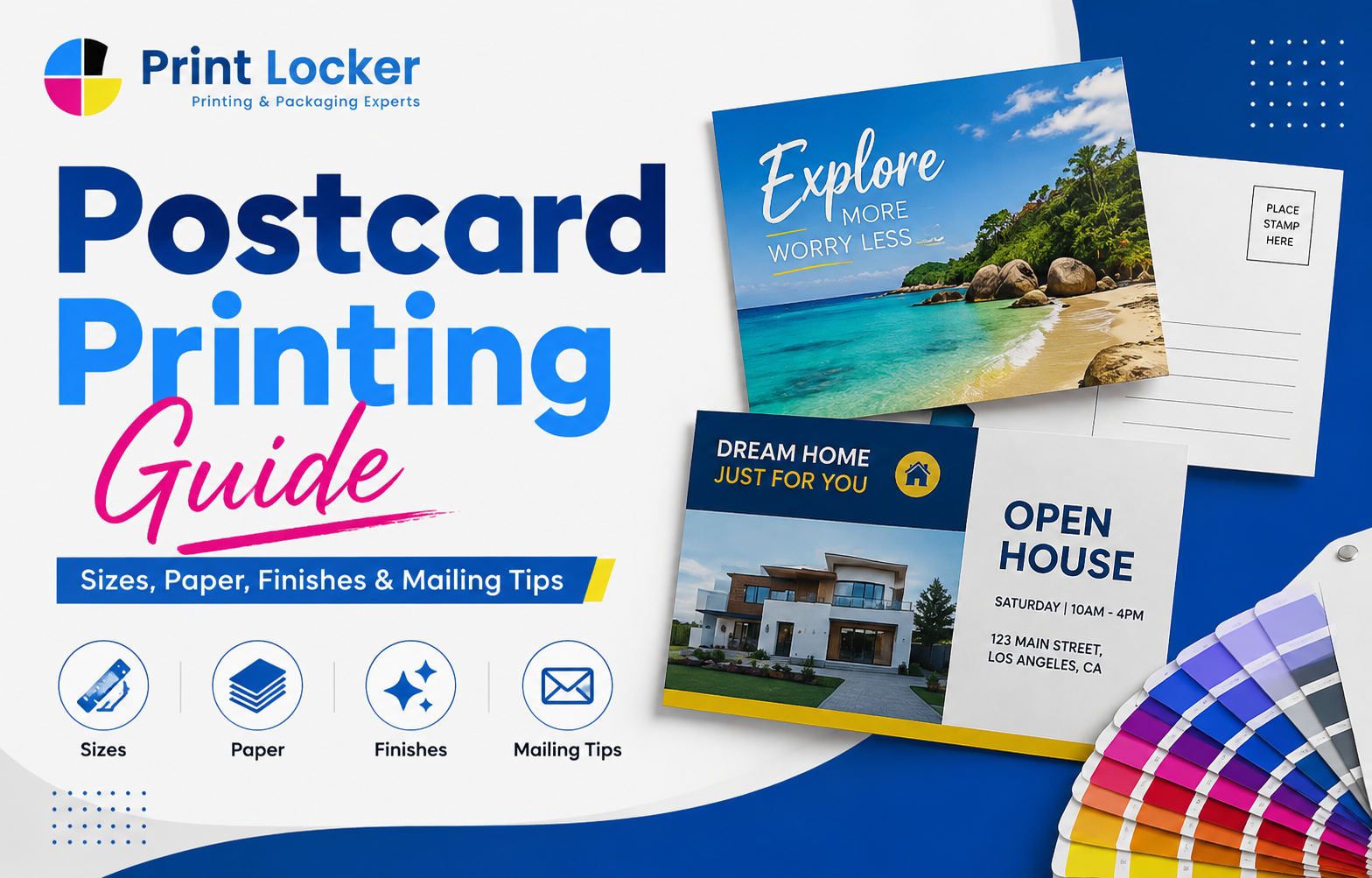
Printed postcards remain one of the most direct, cost-effective ways for a business to get a message into someone’s hands. They show up in mailboxes, get handed out at events, and sit on counters where customers actually see them. Real estate agents use them to announce new listings, restaurants use them to promote a seasonal menu, healthcare offices use them for appointment reminders, and retailers use them to drive foot traffic for a sale.
Before you place an order, it helps to understand how postcard size, paper, finish, and mailing method all work together to shape the final result. This guide walks through everything you need to know to plan a postcard printing project with confidence, from choosing a size to preparing your file to understanding how mailing actually works.
What Is Postcard Printing?
Postcard printing is the process of producing a flat, single card printed with a message, image, and contact information, typically on sturdy cardstock rather than standard paper. Postcards are used for direct mail, in-person promotions, announcements, and marketing campaigns because they deliver a message instantly, with no envelope to open.
Businesses use postcards because they are affordable to produce, quick to design, and effective at grabbing attention in a way a digital ad often cannot. A postcard sitting in a mailbox or handed across a counter gets a moment of undivided attention that a scrolling social feed rarely offers.
Printed postcards and digital marketing are not really competitors; they work best as complements. A postcard can drive someone to a website, a QR code, or a phone number, connecting a physical touchpoint to a digital action. Postcards make the most sense for local promotions, event invitations, seasonal offers, new location announcements, and any message that benefits from a tangible, personal delivery.
Postcards can be distributed in two main ways: through the mail as addressed or unaddressed direct mail, or by hand at events, in stores, or during local outreach. Direct mail works well for reaching a defined geographic area or customer list, while hand distribution works well for events, trade shows, and walk-in retail locations.
What Are the Standard Postcard Sizes?
Postcard sizes are generally described by their width and height in inches, and the size you choose affects how much content fits, how the postcard feels in hand, and in some cases, mailing cost. A few sizes have become the most common choices across the printing industry.
4 x 6 Postcards
The 4 by 6 inch postcard is the most widely used size for simple promotions, announcements, and everyday direct mail. It is compact, economical to print in bulk, and easy to design quickly. This size works well when your message is short and focused, such as a single offer, a save the date, or a quick brand reminder. Choose this size when you want an affordable, high-volume campaign without a lot of design complexity.
5 x 7 Postcards
The 5 by 7 inch postcard gives you noticeably more room for content while still feeling like a postcard rather than a small flyer. This size is popular for business marketing, real estate listings, and campaigns that need space for a photo alongside supporting text. Choose this size when you want more visual impact than a 4 by 6 card can offer, without moving into a bulkier format.
6 x 9 Postcards
The 6 by 9 inch postcard is one of the larger common formats, and it stands out in a stack of mail simply because of its size. This makes it a strong choice for high-visibility campaigns, grand openings, and messages meant to command attention. Choose this size when your campaign depends on the postcard being noticed immediately, since a larger format naturally draws the eye.
Custom Postcard Sizes
Custom sizes make sense when your campaign has a specific creative concept, a unique folded format, or a branding requirement that a standard size cannot accommodate. Custom postcards offer more design flexibility, but they can affect production timelines and, in some cases, mailing costs, so it is worth confirming those details before committing to a non-standard size.
| Postcard Size | Best For | Main Advantage |
| 4 x 6 | Promotions, simple direct mail | Compact and economical |
| 5 x 7 | Business marketing, real estate | More design space |
| 6 x 9 | High visibility campaigns | Larger visual area |
| Custom | Unique campaigns | Flexible design |
A note on mailing eligibility, postal size and pricing rules are set independently by the postal service and can change over time. This guide covers general design considerations, not official postal specifications, so always confirm current mailing requirements directly with your postal provider or your printing service before finalizing a mailed campaign.
How to Choose the Right Postcard Size
The right postcard size depends on how much you need to say, how the postcard will be distributed, and what kind of visual impact you want. As a starting point, choose a smaller size for simple, high-volume campaigns and a larger size when you need more room for images or detailed information.
A few practical questions can help narrow down the decision. How much content do you need to include, just a headline and offer, or a fuller description with images and details? How important is visual impact? Is this a subtle reminder or a piece meant to stand out immediately? What is your budget, since larger sizes generally cost more to print and, in some cases, more to mail? Who is your audience, and does the format match how they are used to receiving information from your business? Finally, consider your campaign type: a quick seasonal promotion often suits a smaller card, while a real estate listing or product launch often benefits from the extra space a larger card provides.
What Paper Is Best for Postcards?
Postcard paper, often called cardstock, is thicker and more rigid than standard printer paper, which gives a postcard its sturdy feel and helps it survive handling and mailing. The right paper choice depends on the look, durability, and brand impression you want to create.
- Cardstock is the base material for postcards, chosen for its durability and rigidity compared to standard paper
- Glossy paper has a shiny, reflective surface that makes colors and photography appear vibrant and sharp
- Matte paper has a non-reflective surface that reads as more understated and professional, and is easier to write on if needed
- Silk paper sits between glossy and matte, offering a smooth, slightly sheened finish often associated with premium print materials
- Premium and specialty stocks, including finishes like metallic or textured papers, are chosen when a brand wants a postcard to feel distinctly upscale
Beyond appearance, paper choice affects durability during mailing and handling, how the postcard feels in hand, whether it can be written on easily, and the overall brand perception it creates. A thin, flimsy postcard can undercut an otherwise strong design, while a well-chosen stock reinforces the professionalism of your message.
What Paper Weight Should You Use for Postcards?
Paper weight is usually described using GSM, which stands for grams per square meter, a measurement of how much a sheet of that paper weighs. In simple terms, a higher GSM number means a thicker, heavier, more substantial-feeling card, while a lower GSM number means a lighter, thinner card.
Heavier paper weight generally creates a more premium feel and holds up better to mailing and repeated handling, which matters if you want your postcard to still look sharp after it travels through the mail. Lighter paper weight can reduce cost for very large print runs, though it may feel less substantial. Paper weight can also affect print quality slightly, since heavier stocks tend to hold ink and color more consistently. For most business postcards, a mid- to heavy-weight cardstock strikes a good balance between durability, appearance, and cost, though the ideal weight depends on your specific goals for the campaign.
Which Postcard Finish Should You Choose?
The finish applied to a postcard changes both how it looks and how it feels, and different finishes suit different types of campaigns.
Glossy Finish
Glossy postcard printing works well for campaigns built around photography, product images, and bright, saturated colors. The reflective surface makes visuals pop, which is why glossy is a common choice for promotional campaigns that lean on strong imagery.
Matte Finish
Matte finish suits professional brands and minimal designs where readability matters more than visual flash. Because it is non-reflective, matte finish is also easier to read under bright light and provides a better surface if the postcard includes an area meant for writing.
Silk Finish
Silk postcard printing offers a smooth, subtly sheened surface that reads as premium without the high shine of a full gloss finish. This makes it a strong option for corporate materials and high-end brands that want a polished look without appearing overly flashy.
Spot UV
Spot UV postcard printing adds a raised, glossy coating to specific areas of a design, such as a logo, headline, or product image, creating contrast against the rest of the card. This finish works well for premium direct mail pieces where a business wants certain design elements to stand out physically as well as visually.
There is no single best finish; the right choice depends on your design, your brand positioning, and what you want the recipient to notice first.
Should You Print on One Side or Both Sides?
Most business postcards benefit from printing on both sides, since it gives you two purposeful spaces instead of one crowded one. The front side is typically responsible for grabbing attention, usually through a bold image, headline, or offer. The back side is where supporting information belongs, including a call to action, contact details, a QR code, and, for mailed postcards, the required mailing information and address area.
A practical recommendation: use the front to stop someone from setting the postcard down immediately, and use the back to give them the specific next step you want them to take, whether that is calling, visiting a website, or scanning a code.
What Should You Put on a Business Postcard?
A strong business postcard usually includes the following elements, though not every postcard needs all ten depending on the campaign.
- Your brand or logo, so the postcard is immediately recognizable as coming from your business
- Your main offer, stated clearly rather than buried in supporting text
- A short headline that captures attention in the first second someone looks at the card
- A supporting message that adds just enough detail to explain the offer or announcement
- An image or visual that reinforces the message, whether that is a product photo, a property image, or branded artwork
- A clear call to action telling the recipient exactly what to do next
- Your website address, so interested recipients know where to go for more information
- A phone number or email address for anyone who prefers to reach out directly
- A QR code where relevant, to bridge the printed postcard to a digital action
- Mailing information, including the required address area if the postcard is being sent through the mail
How to Design a Postcard for Printing
Designing a postcard for print involves a few technical considerations that do not apply to designing for screens, and understanding them ahead of time prevents delays or reprints.
- Keep your headline short. A postcard is read in seconds, so the headline needs to communicate the core message immediately
- Use high-resolution images. Low-resolution photos that look fine on a screen often appear blurry or pixelated once printed
- Choose readable typography. Print reduces contrast slightly compared to a backlit screen, so avoid very thin fonts or low-contrast color combinations
- Respect safe areas. Keep important text and images away from the edges of the postcard, since trimming during production can shift slightly
- Include bleed. Bleed means extending your background design slightly past the final trim line, so there is no thin white edge if the cut shifts even a fraction
- Use the correct color mode. Print files typically use CMYK color rather than the RGB color used for screens, since colors can shift noticeably if this is not accounted for
- Proofread carefully. Once a postcard is printed, a typo or wrong phone number cannot be corrected without reprinting
- Include a strong, specific call to action rather than a vague closing line
- Test any QR code before finalizing your file to confirm it links to the correct destination and scans reliably
Postcard Mailing: What You Need to Know
Mailing a postcard involves more than printing; it also requires understanding how your postcards will actually reach recipients. Direct mail generally falls into two categories: addressed mail sent to a specific mailing list, and unaddressed mail sent to every address within a chosen area.
An addressed mailing list can be built from existing customers, a purchased list, or a database relevant to your campaign. Postage and mailing preparation requirements depend on your mailing method and postcard size, and these details are set by the postal service rather than by any individual printer. Address placement on the postcard typically follows specific formatting rules to ensure proper delivery, and delivery timing can vary depending on the mailing method and volume of your campaign. Because postal requirements can change, always confirm current rules directly with your postal provider or mailing service before finalizing a large campaign.
What Is EDDM?
EDDM stands for Every Door Direct Mail, a mailing method that delivers postcards to every address within a chosen postal route rather than requiring an individual mailing list. It is a useful option for local businesses that want to reach an entire neighborhood or zip code without needing specific names and addresses.
EDDM differs from standard direct mail mainly in targeting method, standard direct mail reaches a curated list of specific recipients, while EDDM reaches every address along a chosen route regardless of who lives there. This makes EDDM postcard printing a practical option for local businesses such as restaurants, retail stores, and service providers who want broad local visibility without building a mailing list from scratch.
Postcards vs Other Marketing Materials
Postcards are one option among several printed marketing materials, and each format tends to suit a different purpose.
| Marketing Material | Best For |
| Postcard | Direct mail and promotions |
| Flyer | Hand distribution |
| Brochure | Detailed information |
| Business Card | Networking |
| Catalog | Multiple products |
If your project needs more space for detailed information, a brochure or a catalog may be a better fit than a postcard, while a postcard remains one of the strongest options specifically for direct mail and quick promotional messaging.
How Many Postcards Should You Print?
The right print quantity depends on your campaign goals rather than a fixed number that applies to every business. A few factors should guide the decision. Your target audience size sets a natural ceiling, since you only need as many postcards as there are recipients on your list or within your chosen mailing area. Your geographic area matters for EDDM-style campaigns, since quantity is tied directly to the number of addresses on a given route.
Campaign size and goals matter as well; a small local test campaign calls for a much smaller run than a full-scale regional promotion. Many businesses run a smaller test campaign first to see how a postcard performs before committing to a larger, repeat campaign based on the results. Bulk printing generally lowers the cost per postcard, so businesses planning multiple campaigns over time often find it more efficient to print larger quantities upfront rather than reordering repeatedly in small batches.
How Much Does Postcard Printing Cost?
Postcard printing cost is shaped by several factors working together rather than a single fixed price. Quantity has one of the largest effects, since printing more postcards at once typically lowers the cost per piece. Size affects cost as well, since larger postcards use more paper and material. Paper choice and finish both influence price, with premium stocks and specialty finishes such as Spot UV generally costing more than a standard glossy or matte card.
Whether you print on one side or both sides affects cost, along with any level of customization beyond a standard template. If your postcards are being mailed, postage and mailing preparation add a separate cost on top of printing. Turnaround time matters too, since a faster production timeline can carry a premium compared to standard processing.
Because postcard pricing depends on the exact combination of these factors, the most reliable way to know your cost is to request a printing quote based on your specific size, quantity, paper, finish, and mailing needs.
How to Choose a Postcard Printing Service
Not every printing service offers the same range of options, and a few factors are worth checking before you commit to a provider.
- Size options, including whether custom sizes are available if your campaign needs one
- Paper options, so you can match the stock to your brand and budget
- Finish options, including whether specialty finishes like Spot UV or metallic are available
- Print quality, since color accuracy and sharpness directly affect how professional your postcard looks
- Quantity flexibility, from small test runs to large bulk orders
- Turnaround time, especially if your campaign has a fixed deadline
- Mailing support, including whether the provider can help prepare or send your postcards
- EDDM support, if you are planning a route-based local campaign
- Proofing process, so you can review your design before full production begins
- Customer support, in case questions come up during your order
PrintLocker offers a full range of postcard printing services covering these areas, including standard postcard printing, specialty finishes such as metallic postcard printing, and folded postcard printing for campaigns that need extra space. Whichever provider you choose, matching their capabilities to your specific checklist above is the most reliable way to avoid surprises once your order is underway.
Postcard Printing for Different Businesses
Real Estate
Real estate agents commonly use postcards to announce new listings, share recent sales in a neighborhood, or promote an open house, taking advantage of the larger visual space a 5 by 7 or 6 by 9 postcard offers for property photography.
Restaurants
Restaurants often use postcards to promote a new menu item, a seasonal special, or a grand opening, distributing them locally through EDDM campaigns or hand delivery within the surrounding neighborhood.
Retail Stores
Retail businesses frequently use postcards to announce sales events, new inventory, or loyalty promotions, often timed around seasonal shopping periods to drive foot traffic.
Healthcare
Healthcare offices use postcards for appointment reminders, wellness campaign announcements, or new patient promotions, where a physical mailer often gets more attention than an email reminder.
Events
Event organizers use postcards as invitations, save-the-dates, or promotional pieces handed out ahead of a conference, fundraiser, or community event.
Local Service Businesses
Service businesses such as landscapers, contractors, and cleaning companies often use EDDM postcards to introduce their services to an entire neighborhood at once, building local brand awareness over time.
E-commerce
E-commerce businesses sometimes use postcards to drive traffic to an online store, announce a sale, or include a printed thank-you card with a QR code linking back to their website.
Postcard Printing Checklist Before You Order
- [ ] Correct size selected
- [ ] Correct quantity confirmed
- [ ] Paper stock selected
- [ ] Finish selected
- [ ] High-resolution images used throughout
- [ ] Bleed included on all edges
- [ ] Spelling and grammar checked
- [ ] Contact details checked for accuracy
- [ ] Clear call to action included
- [ ] QR code tested, if used
- [ ] Mailing requirements checked, if applicable
- [ ] Delivery deadline confirmed
Ready to Print Your Postcards?
Whether you are planning a targeted direct mail campaign or a quick local promotion, choosing the right size, paper, and finish makes a real difference in how your postcard performs. When you are ready to move forward, explore PrintLocker’s postcard printing options or request a quote to get pricing based on your specific project.
❓ FAQs
Q1: What is the best size for a postcard?
The best size depends on your content and campaign goals. A 4 by 6 postcard works well for simple, high-volume promotions, a 5 by 7 postcard offers more room for images and detail, and a 6 by 9 postcard creates the most visual impact for high-visibility campaigns.
Q2: What is the standard postcard size?
4 by 6 inches is generally considered the standard postcard size, since it is the most commonly used format for everyday marketing and direct mail campaigns. Other common sizes include 5 by 7 inches and 6 by 9 inches.
Q3: What paper is best for postcard printing?
The best paper depends on your goals. Glossy paper suits vibrant, photo-heavy designs, matte paper suits professional and minimal designs, and silk paper offers a premium middle ground between the two. A heavier weight cardstock generally creates a more durable, substantial-feeling card.
Q4: Is matte or glossy better for postcards?
Neither is universally better. A glossy finish makes colors and photography appear more vibrant, while a matte finish offers a more understated, professional look and is easier to write on. The right choice depends on your design and brand positioning.
Q5: How much does postcard printing cost?
Postcard printing cost depends on quantity, size, paper, finish, whether you print one or both sides, and any mailing services required. Because pricing varies based on these specifications, the most accurate way to know your cost is to request a quote for your specific project.
Q6: Can postcards be printed double-sided?
Yes. Most business postcards are printed on both sides, using the front for the main message or image and the back for supporting details, contact information, and mailing information if the postcard is being sent through the mail.
Q7: How many postcards should I print?
The right quantity depends on your target audience size, geographic area, and campaign goals rather than a fixed number. Many businesses start with a smaller test campaign and print larger quantities for repeat campaigns once they know how the postcard performs.
Q8: Can postcards be used for direct mail?
Yes, postcards are one of the most common formats used for direct mail campaigns, since they require no envelope and deliver a message immediately upon arrival. Mailing requirements should always be confirmed with your postal provider or mailing service.
Q9: What is the difference between regular postcards and EDDM postcards?
Regular direct mail postcards are sent to a specific list of addresses or names, while EDDM postcards are delivered to every address along a chosen postal route without needing an individual mailing list. EDDM is often used by local businesses seeking broad neighborhood visibility.
Q10: Can I order custom size postcards?
Yes, custom postcard sizes are available for campaigns that need a specific format beyond standard sizes. Custom sizes offer more design flexibility but are worth confirming against production timelines and any mailing requirements before finalizing your order.


