
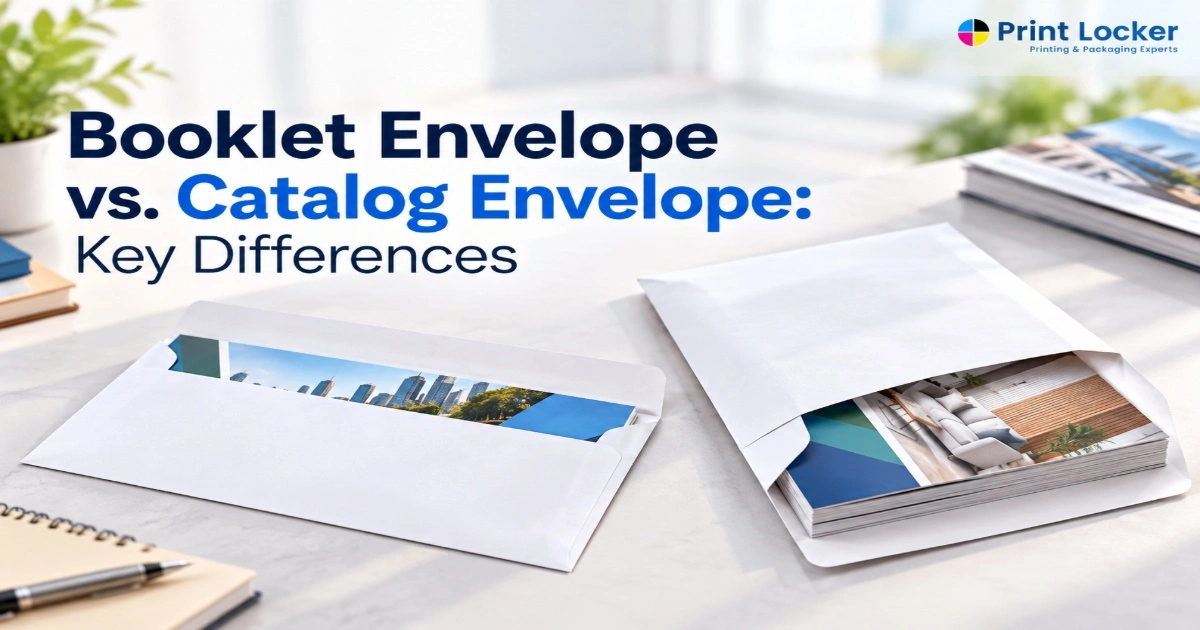
Picking up the right envelope for mailing might feel like a small decision, but it has a significant effect on certain types of documents. If you choose an unsuitable envelope, you might have difficulties inserting papers or accidentally warp them in the process. Two of the commonly used types of envelopes for large mailing tasks are booklet and catalog envelopes. Though they may appear to be quite similar, they differ greatly as far as opening mechanisms and utility are concerned. Go ahead to find out the differences in the designs of these types of envelopes including their standard measurements and how to take your pick of the two, according to your business’ mailing needs.
What Is a Booklet Envelope?
A booklet envelope is the name given to the envelope that is opened at the long side. This type of envelope is generally used for sending booklets, brochures, reports and similar materials, as the long side opening makes it easy to locate items in booklet envelopes. Booklet envelopes are also referred to as open-side envelopes, because of the location of their flap at the long edge.
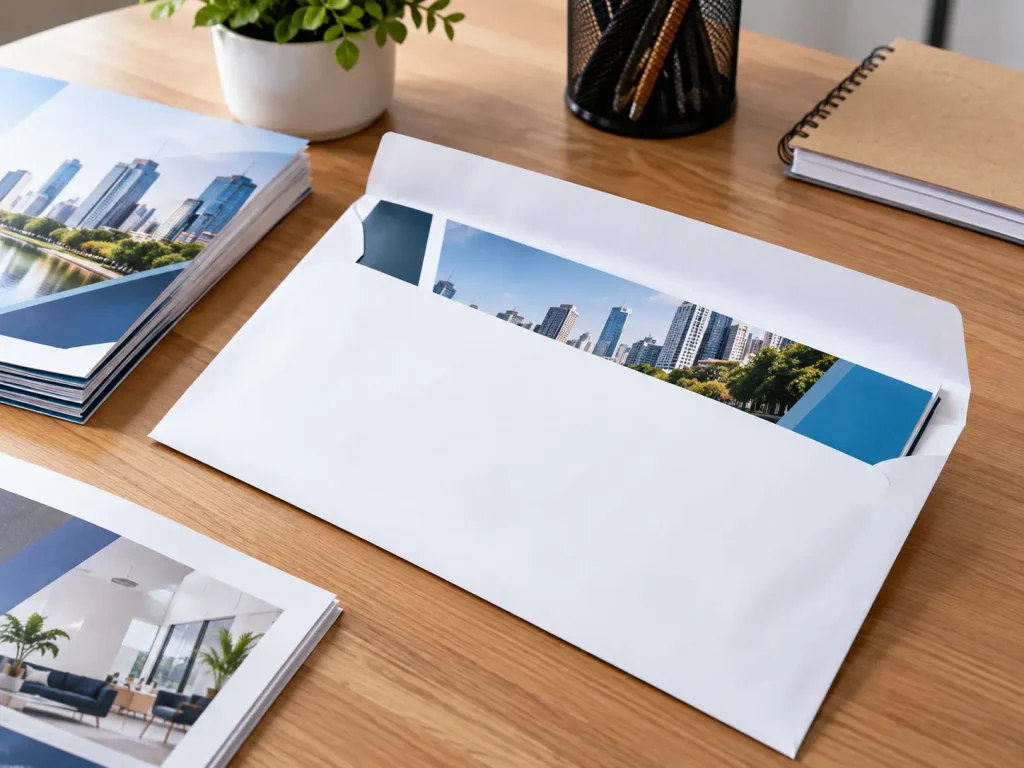
Many businesses choose booklet envelopes for purposes of marketing, presentations, product information or document delivery to clients who expect the items they receive to be professionally presented.
For example, if your company sends a printed company profile or a multi-page promotional booklet to potential clients, a booklet envelope can make inserting the material straightforward. Businesses planning promotional campaigns, corporate presentations or product launches can also benefit from professional Booklet Printing in Los Angeles to create high-quality printed materials that present their brand effectively.
Booklet envelopes come in various sizes, weights of paper and closure types. Depending on the envelope type, it can carry flat printed materials inside without having to fold them.
What Is a Catalog Envelope?
A catalog envelope is an envelope with its opening at its shorter end. Catalog envelopes are referred to as open-end envelopes since the items can be inserted into them through the shorter side rather than the longer side.
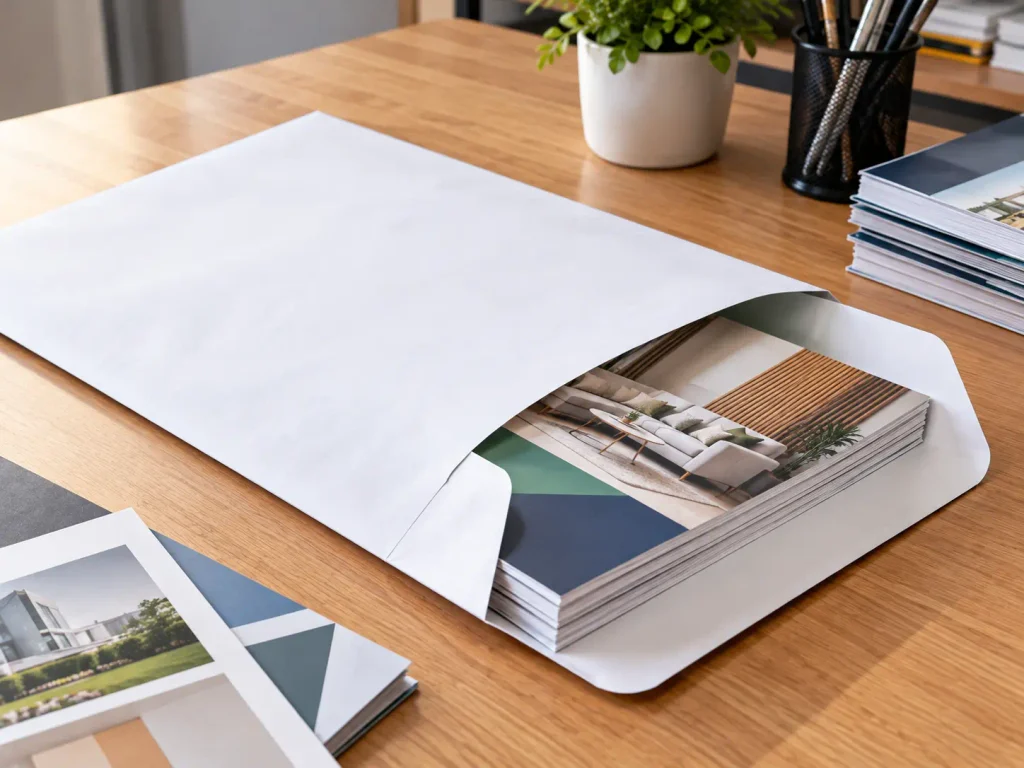
Catalog envelopes are well-known for sending product catalogs, bulky material, reports and advertisement material. Catalog envelopes are designed in such a way that they will be able to be used for applications such as cases where several papers or bulky materials are involved.
For instance, a wholesale business sending a product catalog to potential buyers may choose a catalog envelope to keep the publication flat and protected during delivery. Businesses looking to showcase their product ranges can also use professional Catalog Printing in Los Angeles to create organized, visually appealing catalogs for potential customers, retail partners and wholesale buyers.
Catalog envelopes can be found in different designs, materials and closure techniques. Some types are designed in such a way that they can be reinforced to handle heavier materials. The specific choice of a catalog envelope depends on the weight, thickness and dimensions of what you are sending.
Make sure to check the specifications of the catalog envelope before ordering it to ensure it will accommodate your documents perfectly.
Booklet Envelope vs. Catalog Envelope: Key Differences
The main difference between booklet envelopes and catalog envelopes is the position of the opening. This affects how you insert documents and which applications may be more convenient.
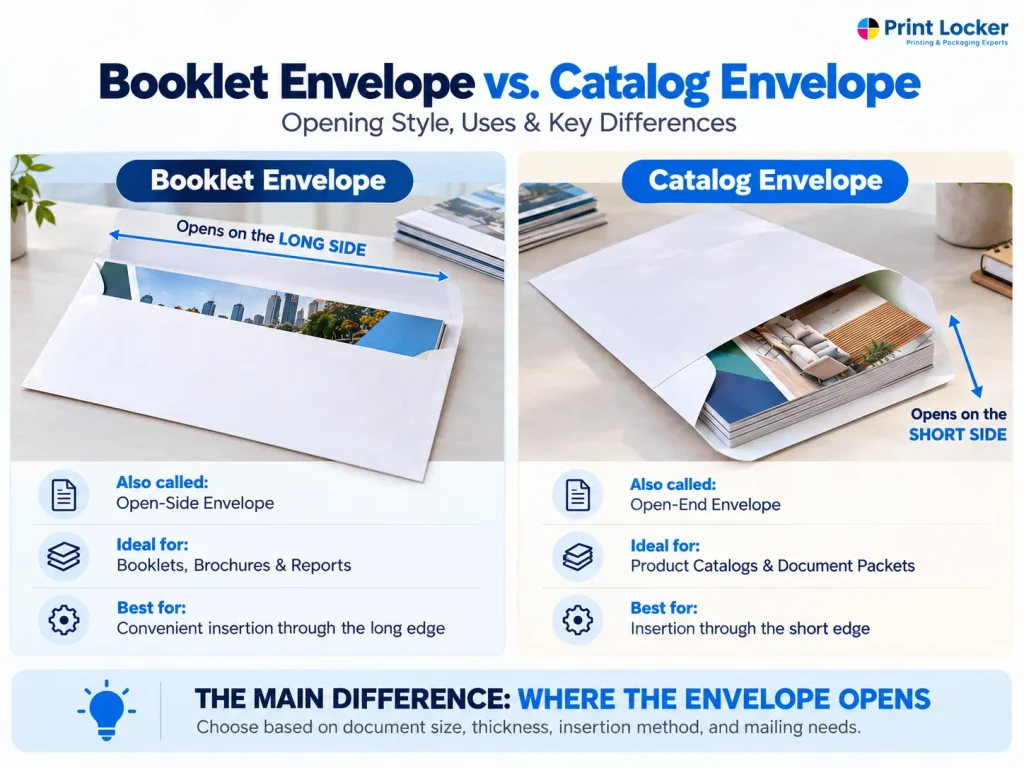
| Feature | Booklet envelope | Catalog envelope |
| Opening | Along the long side | Along the short side |
| Also known as | Open-side envelope | Open-end envelope |
| Typical uses | Booklets, brochures, reports | Catalogs, document packets, printed materials |
| Inserting contents | Through the long edge | Through the short edge |
| Construction | Often features side seams | May feature a center seam or other construction |
| Main consideration | Convenient access and presentation | Contents, loading method and durability |
Both the envelope types can be used for business communications with similar external measurements. The crucial difference lies in the method of envelope opening.
Using a booklet envelope can be useful if you are using a longer side of it to insert paper material. A catalog envelope is preferable when the opening of the shorter side is more suitable for the required papers or the delivery process.
None of the styles is better for all types of mailings. The best option should be chosen based on the type of contents, quality of the envelope and the way the mailing is prepared and sent.
Which Envelope Sizes Are Available?
Envelopes for booklets and catalogs come in different sizes to correspond with various print media, some common sizes being 6 × 9 inches, 9 × 12 inches and 10 × 13 inches. However, several suppliers may have different sizes, depending on the envelope type and style.
It is advisable to measure the size of the final printed product rather than the original paper size so as not to cut or fold the paper while measuring. Ensure that enough room is left to allow for insertion and taking out of the contents safely without damaging the envelope edges.
For example, a 9 × 12 inches envelope can suffice for a flat document with dimensions that fall within the allowed usable interior, but for a thick booklet, it may be necessary to increase the envelope sizes.
Keep these points in mind:
- Measure carefully: Check the width, height and thickness of your finished materials.
- Allow insertion space: Avoid choosing an envelope that fits too tightly.
- Consider the contents: Heavier publications may need a sturdier paper stock.
- Check product specifications: Confirm the usable dimensions, closure style and available sizes before placing an order.
When Should You Choose a Booklet Envelope?
Booklet envelopes are a practical choice when you regularly mail publications or documents that benefit from a long-side opening.
Consider using one for:
- Multi-page brochures and promotional booklets.
- Corporate reports and presentation materials.
- Business proposals and printed company profiles.
- Marketing documents distributed at trade shows or client meetings.
The length of the opening allows for easier insertion of flat mail pieces, especially if many envelopes need to be prepared for a direct mail project. Be sure to verify specifications of the envelope if any automated machines are used to insert the envelope.
When selecting envelopes for business purposes, the size should protect the contents while ensuring a professional look.
When Should You Choose a Catalog Envelope?
Catalog envelopes are a good choice when mailing documents and magazines that require a short-side opening. They are perfect for companies in need of frequently mailing materials on their products.
Consider catalog envelopes for:
- Product catalogs and wholesale price lists.
- Thick document packets and business reports.
- Printed materials that should remain unfolded.
- Publications that need a durable outer envelope for handling and transport.
When sending heavier items, make sure to consider the envelope’s weight, seams, fastening method and maximum loading. This ensures good fit and minimizes the possibility of the item being damaged.
When sending any items of prominent importance, make sure to take preventive measures regarding their packaging depending on how the items will be handled while being sent.
Conclusion
Envelopes, such as booklets and catalogs, have been developed to simplify the different mailing processes of printed marketing materials and business documentation. The major difference between these types of envelopes lies in their style of opening. The style chosen will determine the manner of inserting contents. Before making your choice, make sure you consider the sizes and thicknesses of your documents, envelopes and logistics of mailing.
❓ FAQs
Q1: What is the main difference between booklet and catalog envelopes?
The main difference is the opening position. Booklet envelopes open along the long side, while catalog envelopes open along the short side. Both can hold larger printed materials.
Q2: Are booklet and catalog envelopes available in the same sizes?
Yes, some sizes are available in both styles. However, exact dimensions and availability depend on the manufacturer or printing supplier.
Q3: Which envelope is better for mailing brochures?
Booklet envelopes are often convenient for inserting brochures through the long edge. However, the brochure's dimensions, thickness and preferred insertion method should determine your final choice.
Q4: Can booklet and catalog envelopes be custom printed?
Yes, custom printing may be available for both styles. Businesses can add logos, brand colors, return addresses and promotional designs, depending on the supplier's printing options.
Q5: Are booklet envelopes and catalog envelopes suitable for bulk mailing?
Yes, both envelope types can be used for bulk mailing campaigns. The best option depends on the size and thickness of your contents, mailing equipment compatibility and postal requirements. Always confirm the envelope specifications before ordering in large quantities.
Q6: How do I choose the right paper weight for a booklet or catalog envelope?
Choose the paper weight based on the weight and thickness of the contents. Lightweight documents may work well with standard envelopes, while heavier catalogs or multiple-page booklets may require sturdier paper. Consider the mailing method and handling conditions to ensure adequate protection.


